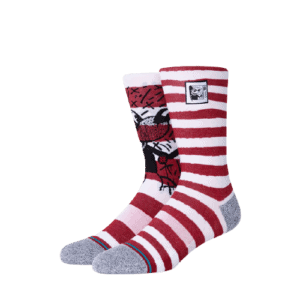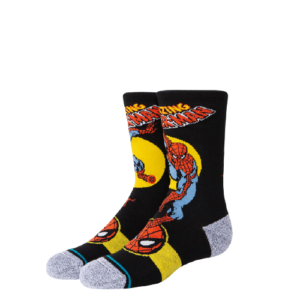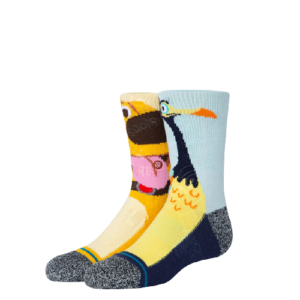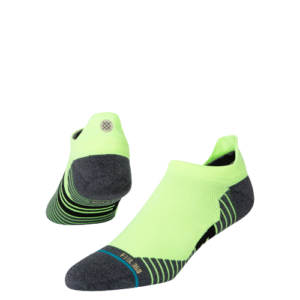
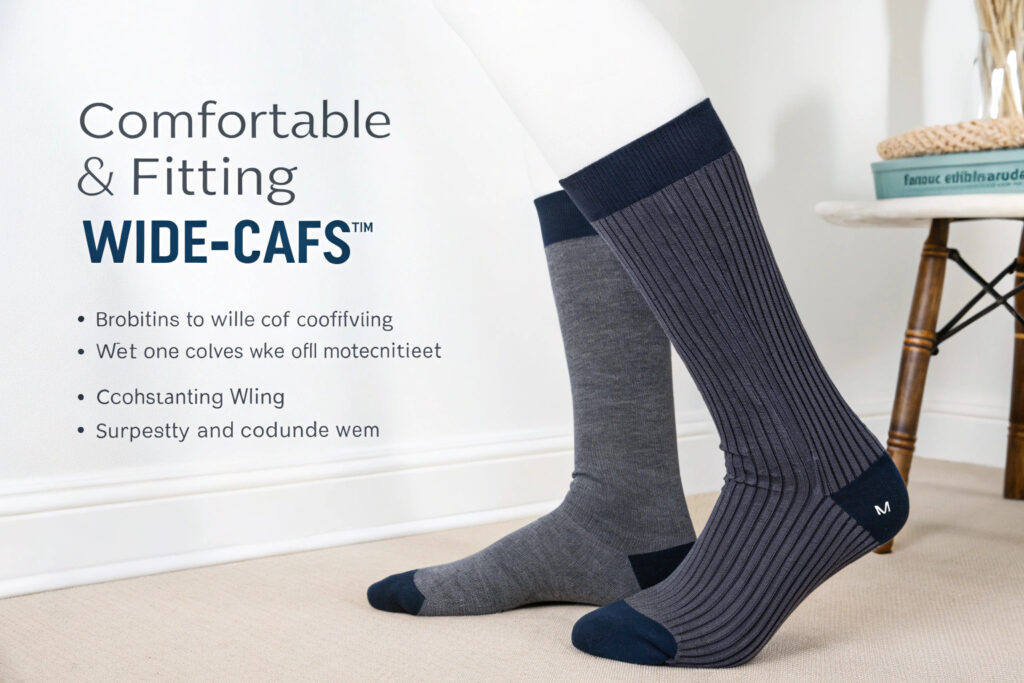
Finding comfortable and well-fitting socks for wide calves can be a real struggle. Many people experience socks that are too tight, cut off circulation, or simply don’t stay up. This is a common pain point for your customers, leading to returns and dissatisfaction. As a manufacturer, we see this not as a niche problem, but as a significant opportunity to provide a better product.
The key to developing successful socks for wide calf sizes lies in the precise engineering of stretch material ratios. It’s not just about adding more spandex; it’s about scientifically balancing yarns like nylon and spandex to create a sock that offers expansive stretch without compromising on durability, shape retention, or comfort. This approach ensures the sock conforms to the leg without excessive pressure.
In this guide, we will break down the entire development process. You will learn how to select the right materials, calculate the perfect stretch ratios, and implement design features that truly work. Let’s dive into creating socks that offer a superior fit for a wider audience.
What is the best fabric blend for wide calf socks?
The quest for the perfect wide calf sock starts at the very foundation: the fabric blend. A poor choice here leads to socks that sag, lose shape, or feel constricting. The ideal blend must provide multidirectional stretch, excellent recovery, and softness against the skin.
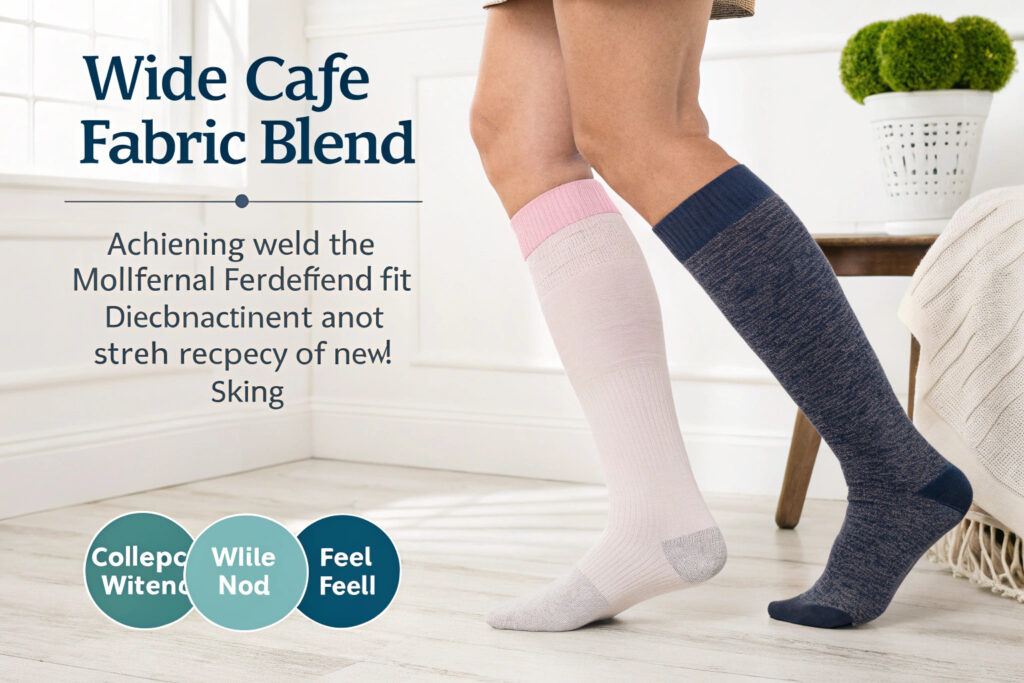
The best fabric blend for wide calf socks is a combination of Nylon and Spandex (also known as Elastane). Nylon provides the essential durability and strength, while Spandex is responsible for the stretch and recovery. A typical high-performance ratio is 80% Nylon to 20% Spandex. This balance allows the sock to expand significantly to accommodate wider calves and then spring back to its original shape after washing and wearing, preventing bagginess.
Why is Nylon so crucial for durability?
Nylon is a synthetic polymer known for its exceptional strength and abrasion resistance. In socks, it acts as the backbone of the fabric. Without a strong base fiber like Nylon, the high spandex content needed for stretch would make the sock delicate and prone to tearing or developing holes quickly. The robust nature of Nylon ensures that the sock can withstand the stresses of stretching over the calf and daily wear, significantly enhancing its lifespan. For a deeper understanding of fiber science, the Textile Institute offers extensive resources.
How does Spandex percentage affect the stretch?
The percentage of Spandex directly controls the sock’s elasticity. A standard sock might contain 5-10% Spandex. For wide calf socks, this percentage must be increased, often to 15-20% or even higher for maximum comfort. This high Spandex content creates what we call "mechanical stretch," providing the power needed to expand without feeling like it’s squeezing the leg. However, it’s a delicate balance; too much Spandex can make the sock difficult to put on and take off. The ASTM International standards provide guidelines for measuring these elastic properties accurately.
How to calculate the correct stretch ratio for wide calves?
Knowing the right materials is only half the battle. The next critical step is translating that into a precise stretch ratio, which is the blueprint for a perfect fit. An incorrect calculation results in a product that fails its primary function.
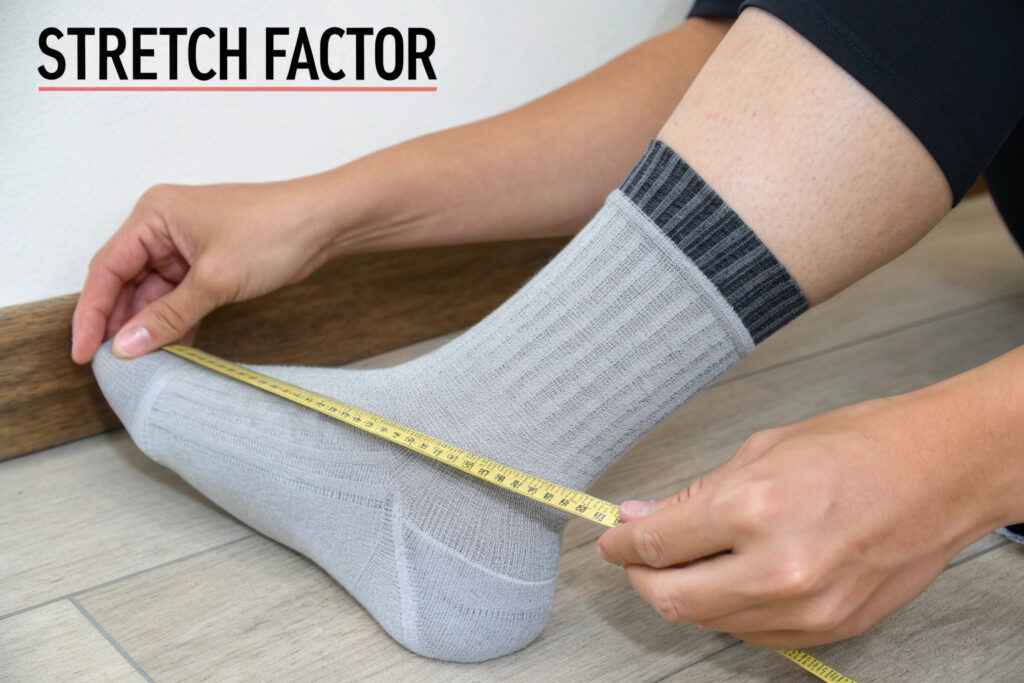
Calculating the correct stretch ratio involves precise measurements of the calf circumference and the sock’s fabric width. The key metric is the "Stretch Factor." You take the fully stretched width of the sock fabric and divide it by the relaxed width. For wide calf socks, a stretch factor of 1.8 to 2.2 is often ideal, meaning the sock can stretch to 1.8 to 2.2 times its original width. This ensures it can comfortably fit larger calf sizes without over-straining the material.
What measurements are needed for the calculation?
You need two core measurements: the target calf circumference and the fabric’s relaxed width. First, define the specific wide calf circumference you are designing for (e.g., 18 inches). Then, you measure the sock panel’s width in its relaxed, unstretched state. The stretch ratio is the target circumference divided by the relaxed fabric width. For example, to fit an 18-inch calf, if your relaxed fabric is 9 inches wide, you need a stretch ratio of 2.0 (18/9=2). This precise engineering is why we invest in a CNAS-certified lab for accurate testing.
How does gauge or stitch density impact the fit?
Gauge, which refers to the number of needles per inch in the knitting machine, directly influences the stitch density and thus the fit. A finer gauge (like 200 needles) creates a denser, smoother fabric with more controlled, even stretch. A coarser gauge (like 84 needles) creates a more open, bulkier fabric that may have more "give" but less precision. For wide calf socks, a medium to fine gauge is often preferred as it provides a sleek, comfortable fit that doesn’t feel bulky under boots or pants. Understanding knitting machine specifications is fundamental for this stage of development.
What design features enhance comfort for wide calves?
Material and ratios provide the foundation, but intelligent design features elevate a wide calf sock from merely fitting to being genuinely comfortable and functional. These elements address common issues like top-band tightness and overall leg contour.
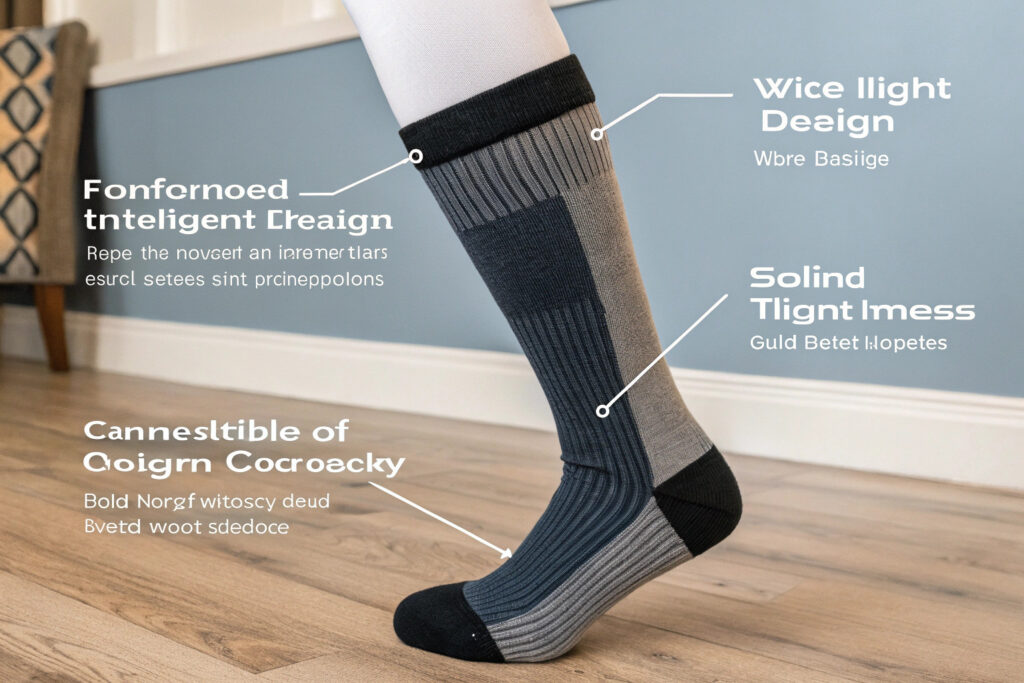
Key design features that enhance comfort include a wide, non-binding elastic top band, a contoured leg design, and a seamless toe closure. A wider top band distributes pressure over a larger surface area, eliminating the dreaded "sock ring" on the skin. A contoured leg, which is wider at the calf and narrower at the ankle, follows the natural shape of the leg for a custom-like fit without excess fabric bunching.
Why is a wider top band essential?
A standard narrow top band on a wide calf sock acts like a tight rubber band, cutting into the skin and restricting blood flow. A wider top band, typically 1.5 to 2 inches wide, spreads the necessary holding force across a broader area. This significantly reduces point pressure, making the sock feel secure yet comfortable enough to wear all day. It’s a critical feature for individuals with sensitivity or circulation concerns. This focus on comfort aligns with principles of ergonomic clothing design.
How does a contoured leg improve the fit?
A straight-tube sock design does not accommodate the natural taper of the leg from the calf to the ankle. For a wide calf, this means either the calf is too tight or the ankle is too loose. A contoured leg is knitted with specific increases and decreases in stitches to create a shape that is wider at the calf and narrower at the ankle. This anatomical approach ensures the fabric hugs the leg smoothly without gaps or constriction, providing a sleek silhouette and preventing the sock from sliding down. Advanced CAD for knitting technology is often used to program these complex shapes.
How to ensure quality in wide calf sock production?
Development is meaningless without consistent, high-quality production. For wide calf socks, quality control checks must be even more rigorous to ensure the promised stretch and comfort are delivered in every single pair.
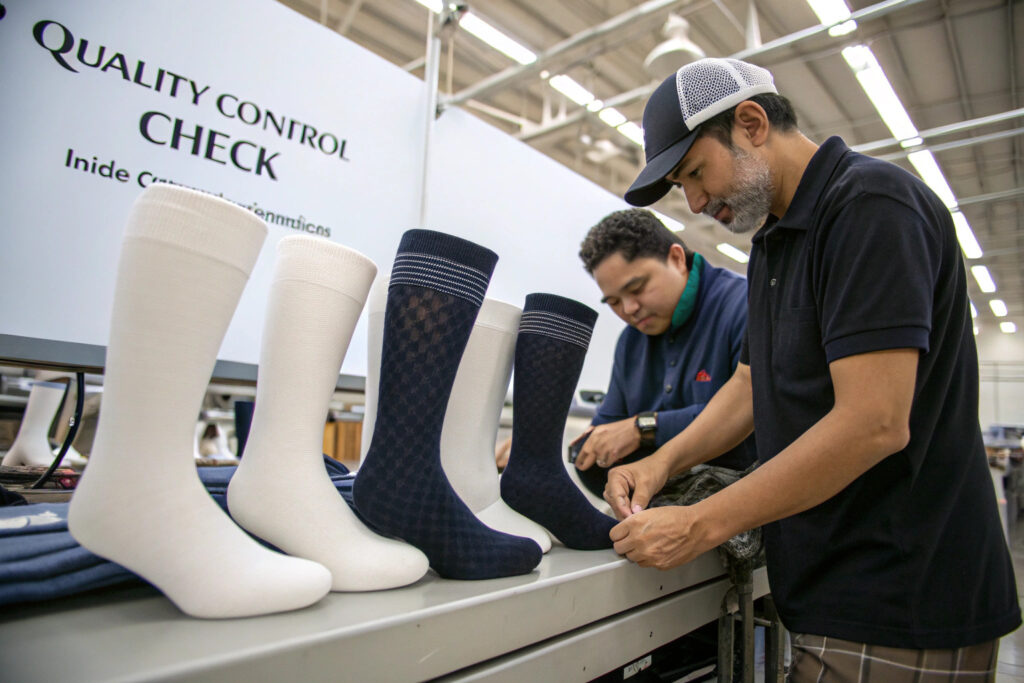
Ensuring quality in wide calf sock production requires a multi-stage QC process focused on stretch recovery, seam integrity, and size consistency. This involves pre-production testing of yarns, in-line monitoring during knitting, and final inspection of the finished socks. Key tests include repeatedly stretching the sock to its limit and verifying it returns to its original shape, checking for weak points in the toe and heel, and confirming the calf circumference is within tolerance.
What tests verify stretch and recovery?
The most important test is the Cyclic Stretch Recovery Test. In our lab, socks are mechanically stretched to a specified percentage (e.g., 150% of their relaxed width) for a set number of cycles. After this stress test, we measure how closely the sock returns to its original dimension. A high-quality sock will have over 95% recovery. This prevents the socks from becoming loose and baggy after a few wears and washes. Our methods are aligned with international standards from ISO.
Why is size grading critical for different wide calf sizes?
"Wide calf" is not one size. Offering a single wide-calf option excludes a large portion of the market. Proper size grading is therefore critical. This means creating a full size run (e.g., S, M, L, XL) where each size has a proportionally graded calf circumference and leg length. For instance, an XL wide-calf sock should have a larger circumference than a L wide-calf sock, not just a longer foot. This systematic approach ensures every customer finds a sock that fits their specific calf dimensions perfectly, which is a core principle of inclusive apparel design.
Conclusion
Developing socks for wide calf sizes is a precise science that blends material expertise, calculated engineering, and thoughtful design. By mastering the nylon-spandex ratio, accurately calculating stretch factors, incorporating comfort-focused features, and enforcing rigorous quality control, you can create products that meet a vital market need. This approach transforms a common customer frustration into an opportunity for brand loyalty and growth.
If you are looking for a manufacturing partner that understands the intricacies of developing high-performance socks for wide calf sizes and other specialized segments, we are here to help. At GlobalSock, we combine our decade of experience in the heart of China’s textile district with cutting-edge technology to bring your vision to life. For a direct conversation about your specific needs, please contact our Business Director, Elaine, at her email: elaine@fumaoclothing.com. Let’s create socks that fit everyone perfectly.