Getting sock sizes wrong can destroy your business in international markets. You face returns, unhappy customers, and damaged reputation when socks don’t fit properly across different regions.
Accurate sock size grading for global markets requires understanding regional foot dimension variations, implementing standardized sizing systems like Mondopoint, and creating customized size charts that accommodate width and length differences across North America, Europe, and Asia. Successful global sock suppliers combine anthropometric data with flexible production capabilities to deliver properly fitting products worldwide.
The complexity comes from anatomical differences between populations and varying size expectations. Let me share the precise methodology we’ve developed over a decade of supplying 30+ countries from our manufacturing hub in Keqiao.
What are the key differences in sock sizing standards?
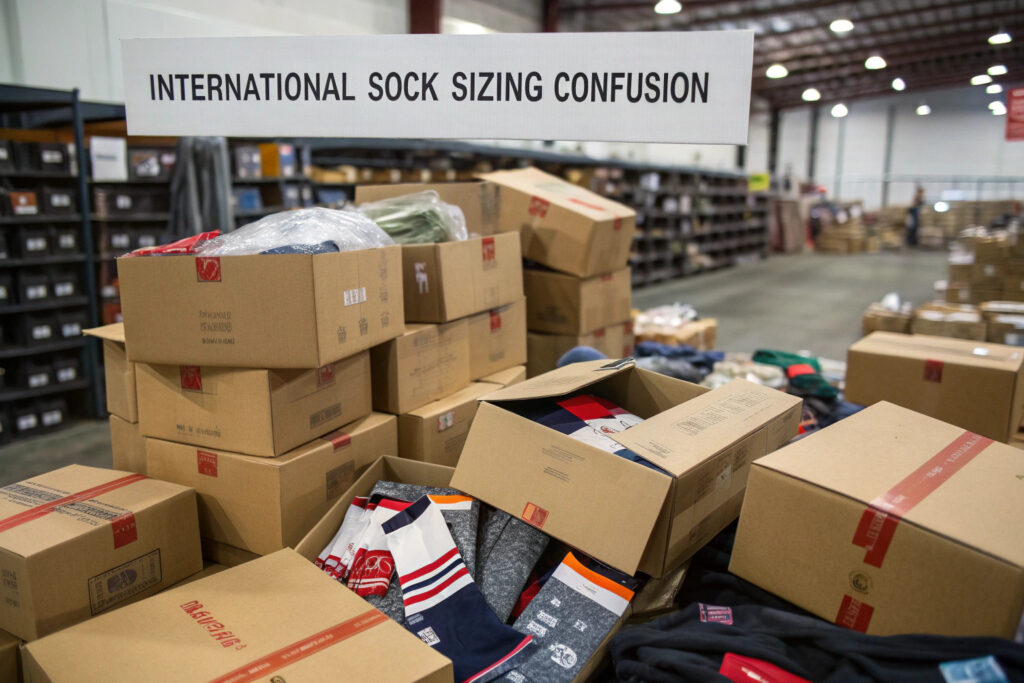
International sock sizing confusion costs businesses millions in returns annually. You might be using one standard that fails completely in another market.
The primary differences lie in measurement systems, sizing increments, and width accommodations. The US uses numerical sizes with clear gender divisions, Europe employs the Mondopoint system in centimeters, while Asia often uses smaller numerical ranges with different fit expectations.
How does US sock sizing compare to European standards?
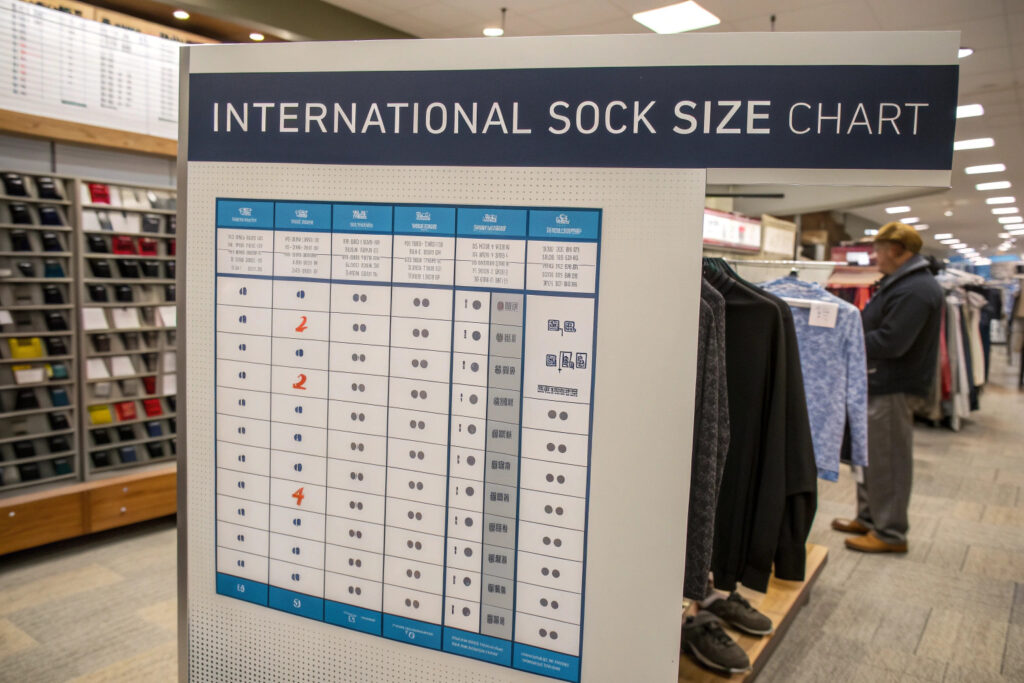
US sock sizing typically ranges from 10-13 for men and 9-11 for women, corresponding to shoe sizes. European sizing uses the Mondopoint system which measures exact foot length in centimeters. For example, a US men’s size 11 translates to EU 44-45. The European system provides more precision with 1-centimeter increments between sizes, while US sizing uses broader categories. This precision matters significantly for compression socks and athletic performance footwear where exact fit is critical. The American Society for Testing and Materials provides detailed size standardization guidelines that many US manufacturers follow.
Why do Asian markets require different sizing approaches?
Asian foot anatomy typically features narrower widths and shorter lengths compared to Western markets. Where a US medium might fit foot lengths 9.5-10.5, an Asian medium often covers 8.5-9.5. This isn’t just about scaling down sizes – the foot volume and proportions differ significantly. Japanese and Korean markets particularly expect slimmer profiles and tapered fits. Understanding these anatomical differences is crucial for reducing return rates. The International Textile Manufacturers Federation offers research on global anthropometric data that informs these regional sizing adaptations.
How to create accurate international sock size charts?
Developing size charts that work across borders prevents customer frustration and reduces return rates that eat into your profits.
Create international sock size charts by collecting regional foot measurement data, implementing a dual-size labeling system, and providing detailed fit guidance for each market segment. The most effective charts account for both length and circumference variations.
What body measurements are essential for global sizing?
The critical measurements for global sock sizing include foot length, ball circumference, instep height, and ankle circumference. For compression wear and medical socks, calf measurements become equally important. Our CNAS-certified lab conducts regular anthropometric studies across our key markets, revealing that European customers typically need more instep room while North American markets require wider toe boxes. These subtle differences dramatically impact perceived comfort and quality. The International Organization for Standardization provides global sizing guidelines that form the foundation of proper size chart development.
How should size charts accommodate width variations?
Progressive size charts include both length and width dimensions, often using a letter system (N for narrow, M for medium, W for wide) alongside numerical sizes. This approach is particularly important for markets like Germany and the UK where foot width varies significantly within the same length category. Our factory implements flexible knitting technologies that automatically adjust width parameters without changing length specifications, allowing us to efficiently produce multiple width options for the same size. This technical capability has been crucial for our partnerships with European brands requiring precise fit specifications.
What production adjustments ensure proper global fit?
Standard knitting programs often fail when applied to international markets, leading to inconsistent fit and customer dissatisfaction.
Global fit requires specialized knitting machine programming, elastic tension adjustments, and material selection tailored to regional preferences and foot shapes. The production process must be as adaptable as your size charts.
How does knitting machine programming affect international sizing?
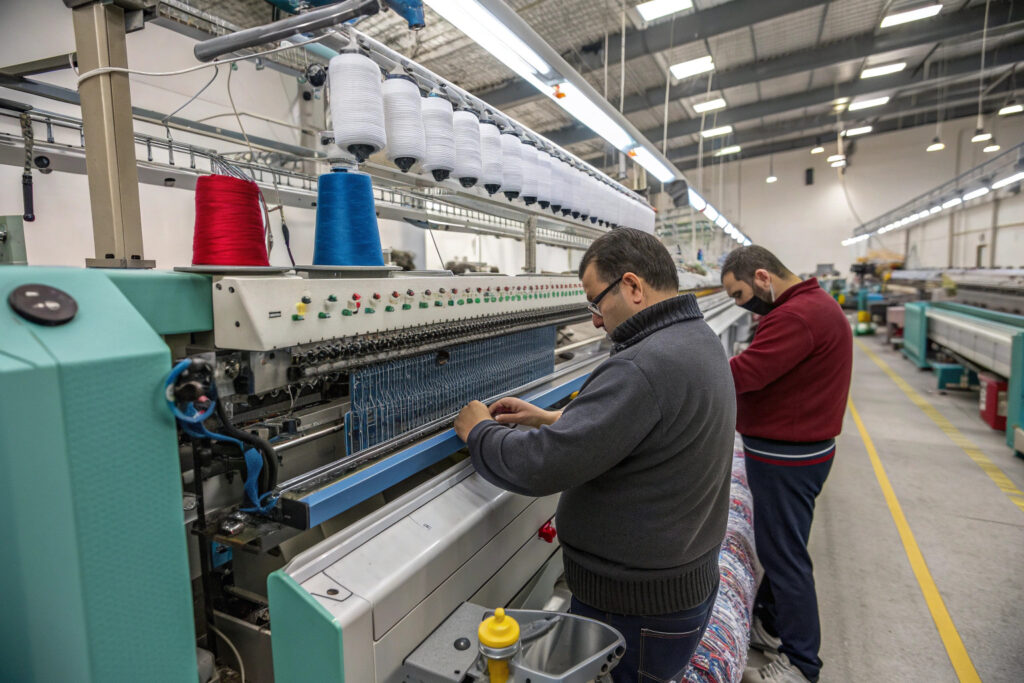
Modern computerized knitting machines allow precise adjustments to stitch density, tube diameter, and heel pocket depth. For Asian markets, we program tighter elastic integration and narrower tube diameters. For North American production runs, we increase the circumferential stitches and reinforce high-stress areas differently. Our factory’s agile manufacturing system maintains 15 different base programs that we modify further based on specific customer requirements. This technical flexibility has been key to our success supplying everything from Japanese tabi socks to American athletic crew socks from the same production facility.
Why does material selection impact sizing consistency?
Different materials have varying stretch recovery properties that significantly affect fit over time. Nylon/spandex blends common in European fashion socks maintain shape differently than the organic cotton preferred in North American casual socks. Our quality control team tests each material’s recovery percentage after repeated stretching to ensure the labeled size remains accurate through the product’s lifespan. We’ve found that bamboo blends require different size specifications than merino wool to achieve the same fit, which is why we maintain separate size charts for each material category in our technical packages.
How to implement quality control for international sizing?
Without proper verification, even well-designed size charts can fail during production, leading to inconsistent products and customer complaints.
Implement dimensional stability testing, regular production audits, and market-specific validation to maintain sizing accuracy across global markets. Quality control must verify both initial measurements and long-term fit performance.
What specific measurements should quality control track?
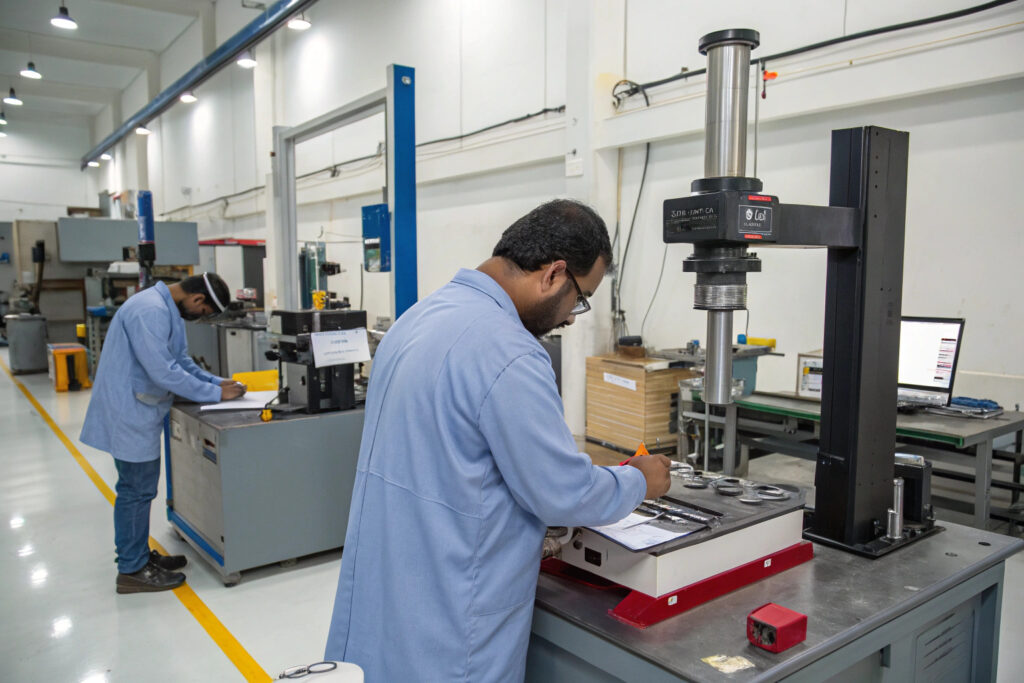
Our end-to-end quality control tracks eight critical dimensions: overall length, foot length, leg opening circumference, calf circumference (for longer styles), heel pocket depth, toe closure integrity, and post-wash dimensional stability. We maintain different tolerance standards for different markets – European luxury brands typically require ±0.5cm precision, while basic athletic socks for mass merchants might allow ±1cm. Our CNAS-certified testing center uses standardized measurement protocols adapted from international textile testing standards to ensure consistency across production batches and manufacturing locations.
How does wash testing prevent international sizing failures?
Wash testing simulates real-world use across different laundering cultures. European consumers typically wash at lower temperatures with different detergents than North American consumers, while Asian markets often air-dry rather than machine-dry. These care differences dramatically impact how socks maintain their size. Our testing protocols include 25 wash cycles using regional detergents and methods, measuring dimensional changes at 5-cycle intervals. This data informs both our production specifications and the care instructions we provide to each market, significantly reducing post-purchase sizing complaints.
Conclusion
Mastering sock size grading for global markets requires deep understanding of regional anatomical differences, precise production adjustments, and rigorous quality control. The most successful suppliers combine anthropometric data with flexible manufacturing capabilities to deliver products that fit correctly across diverse international markets. By implementing standardized yet adaptable sizing systems, you can significantly reduce returns and build stronger global brand loyalty.
If you’re looking for a manufacturing partner with proven expertise in global sock sizing and production, we can help. Our experience supplying 30+ countries has given us unique insights into international fit requirements. Contact our Business Director Elaine at elaine@fumaoclothing.com to discuss how we can develop properly graded sock collections for your target markets.