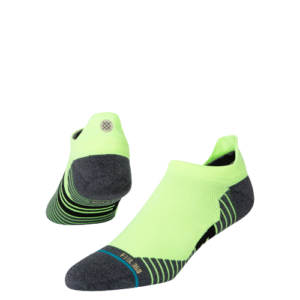
When you’re sourcing performance socks for the US market, your customers demand more than just comfort. They expect advanced moisture management that keeps feet dry during intense activities. As a leading socks manufacturer, we’ve seen how improper wicking testing leads to product returns and brand damage. The real question isn’t whether socks wick moisture – but how quickly and efficiently they do so.
Performance socks must move sweat away from the skin rapidly to prevent blisters, discomfort, and fungal growth. Proper wicking speed testing separates market-leading products from mediocre ones. At GlobalSock, we’ve developed precise laboratory methods that simulate real-world conditions to ensure your socks perform exactly as promised when customers need them most.
Understanding these testing protocols will help you make informed sourcing decisions and deliver superior products to your market. Let’s explore how professional laboratories measure this critical performance characteristic.
What is Moisture Wicking in Socks?
Moisture wicking is the technical process where socks pull sweat away from your skin and move it to the outer surface where it can evaporate. This isn’t just absorption – it’s active liquid transport through capillary action within the fibers. For athletes and active consumers, this means drier feet, reduced blister risk, and enhanced comfort during physical activities.
The science behind wicking involves capillary action, where moisture moves through tiny spaces between fibers or through hollow channels within specialized yarns. This physical process doesn’t rely on chemicals alone but on the engineered structure of the textiles. High-performance socks combine specific fiber cross-sections, yarn construction, and knitting patterns to maximize this capillary effect.

How Does Capillary Action Work in Socks?
Capillary action occurs when liquid spontaneously rises in narrow spaces without external forces. In socks, this happens through the microscopic gaps between fibers or through specially engineered micro-channels in technical yarns. The same physical principle that causes water to climb up a thin tube drives moisture away from your skin in high-performance socks.
At our CNAS-certified testing lab, we’ve measured how different fiber configurations affect wicking speed. Hollow-core fibers like those used in our BAMSILK bamboo blends create consistent channels for rapid moisture transport. The fiber’s cross-section, surface energy, and packing density all contribute to how effectively socks can pull moisture away from skin.
Why is Wicking Speed Critical for Athletic Performance?
Wicking speed directly impacts athletic performance by maintaining optimal foot conditions. During high-intensity activities, feet can produce over half a cup of sweat per hour. Slow-wicking socks leave this moisture against the skin, leading to saturation that causes blisters, discomfort, and temperature dysregulation.
Fast wicking preserves the microclimate next to your skin. Our testing shows that socks with wicking times under 3 seconds prevent the 70% friction increase that occurs when skin becomes oversaturated. For marathon runners, tennis players, and hiking enthusiasts, this difference can determine whether they finish their activity comfortably or with painful foot damage.
Which Standard Methods Test Wicking Speed?
International standards organizations have developed precise testing protocols to measure wicking speed objectively. The American Association of Textile Chemists and Colorists (AATCC) method 197 is the most widely recognized vertical wicking test, while ISO 9073-6 addresses horizontal wicking properties. These standardized methods ensure consistent, comparable results across different manufacturers and testing facilities.
At GlobalSock, we employ both AATCC 197 and modified versions that simulate actual wear conditions. The standard vertical wicking test measures how high moisture travels up a fabric sample in a specific time frame. However, we’ve enhanced this with dynamic pressure testing that mimics the compression and movement of socks during athletic activities.

What is the AATCC 197 Vertical Wicking Test?
The AATCC 197 Vertical Wicking Test is the gold standard for measuring how quickly moisture moves upward through textiles. In this method, a strip of sock fabric is suspended vertically with its bottom edge immersed in a reservoir of distilled water containing a blue dye tracer. Technicians measure how high the moisture travels at specific time intervals – typically 1cm, 5cm, and 10cm heights.
The test requires controlled laboratory conditions of 21°C ± 1°C and 65% ± 2% relative humidity to ensure consistent results. Our quality team records both the distance traveled and the speed of travel, providing clients with comprehensive moisture management data that predicts real-world performance. This method effectively compares different materials and construction techniques for their wicking capabilities.
How Does Horizontal Wicking Testing Differ?
Horizontal wicking tests measure how quickly moisture spreads laterally across fabric, which is equally important for overall foot comfort. While vertical wicking pulls moisture away from skin, horizontal distribution ensures sweat doesn’t pool in specific areas. The ISO 9073-6 standard uses a circular fabric sample with water introduced at the center, measuring the radius of moisture spread over time.
We’ve found that combining vertical and horizontal wicking data gives the most accurate prediction of in-sock performance. Some advanced synthetic blends show excellent vertical wicking but poor horizontal spread, creating wet spots directly under high-sweat areas. Our comprehensive testing protocol evaluates both dimensions to ensure complete moisture management throughout the entire sock surface.
What Equipment Measures Wicking Accurately?
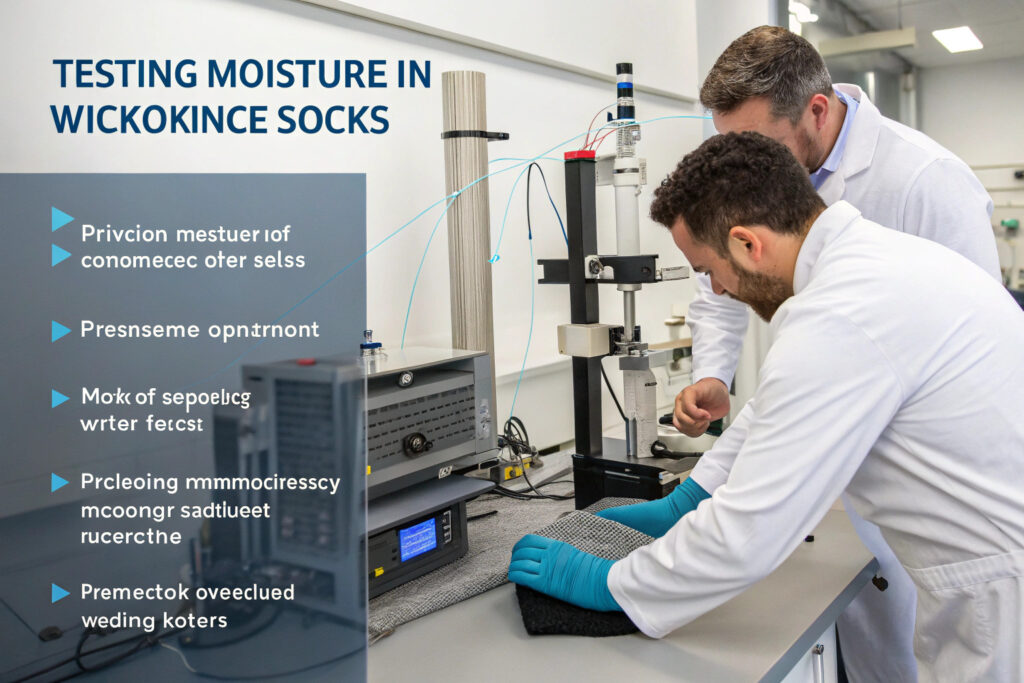
Precision laboratory instruments are essential for accurate wicking measurement. Standard equipment includes vertical wicking test stands with calibrated scales, horizontal wicking plates with concentric circles, high-resolution cameras for documentation, and controlled environment chambers. Advanced facilities like ours also use moisture mapping systems with electronic sensors that detect minute changes in fabric conductivity as moisture travels.
The most significant innovation in wicking measurement is the use of thermal imaging cameras that visualize temperature changes as moisture evaporates. This non-contact method provides real-time data without disturbing the fabric sample. We combine this with gravimetric analysis that weighs samples at millisecond intervals to calculate wicking rates with exceptional precision.

How Do Electronic Moisture Sensors Work?
Electronic moisture sensors detect changes in electrical conductivity as water replaces air between fibers. These systems use micro-electrodes placed at precise intervals along a fabric sample. When moisture reaches each electrode, the conductivity change triggers a timestamp, allowing exact calculation of wicking speed between measurement points.
Our laboratory utilizes the Moisture Management Tester which features multiple concentric rings of sensors that measure both top-to-bottom and radial spreading simultaneously. This provides a three-dimensional understanding of how socks manage moisture. The data generated helps our R&D team refine knitting structures and fiber blends for optimal performance.
Why Use Thermal Imaging for Wicking Analysis?
Thermal imaging cameras detect subtle temperature variations caused by evaporative cooling as moisture moves through fabric. This non-contact method provides visual data that complements quantitative measurements from other instruments. The thermal signatures clearly show moisture pathways and identify potential dead zones where wicking is inefficient.
We’ve integrated FLIR thermal imaging systems into our standard testing protocol because they reveal aspects of wicking behavior that traditional methods miss. For example, some yarn constructions create preferential pathways that leave entire sections of fabric dry while others become oversaturated. This information is crucial for designing socks that distribute moisture evenly across all foot zones.
How to Interpret Wicking Test Results?
Interpreting wicking test results requires understanding both the numerical data and its practical implications for wearers. Key metrics include initial wicking time (when moisture first begins moving), average wicking speed (cm/min), maximum wicking height, and moisture distribution pattern. Superior performance socks show rapid initial wicking (under 3 seconds), consistent speed throughout the test, and even distribution without channeling.
At GlobalSock, we translate technical data into practical performance predictions. For example, socks with wicking speeds above 2cm/min in vertical tests will keep feet dry during moderate exercise, while high-intensity activities require speeds exceeding 4cm/min. We provide clients with simple rating systems that help them select appropriate materials for their target market and price point.

What Are the Minimum Wicking Standards?
Industry minimum standards vary by application, but general performance socks should achieve vertical wicking of at least 1cm within 5 minutes according to AATCC 197. Premium athletic socks typically reach 5cm within 10 minutes, while elite performance models can wick 10cm in under 5 minutes. These thresholds ensure adequate moisture management for their intended use cases.
Our quality control department maintains even stricter standards, rejecting any production batches that fall below 2cm wicking within 3 minutes for our sports collection. We’ve established these benchmarks through extensive wear testing with athletes across different sports. This commitment to exceeding minimum requirements has made us the preferred socks manufacturer for professional sports teams in Europe and North America.
How Does Wicking Relate to Other Performance Factors?
Wicking performance interacts significantly with other sock characteristics. High wicking speeds often correlate with better breathability but may require trade-offs with cushioning thickness. Similarly, antimicrobial treatments can slightly reduce wicking speed but prevent odor buildup in moist environments. Understanding these interactions helps create balanced products for specific applications.
Our technical team analyzes how wicking interacts with compression, abrasion resistance, and thermal regulation. For example, we’ve developed exclusive moisture management systems that maintain wicking efficiency even in heavily cushioned areas through strategic channel placement. This holistic approach to performance testing ensures every sock we produce delivers comprehensive benefits rather than excelling in just one area.
Conclusion
Testing wicking speed through standardized laboratory methods provides the objective data needed to create high-performance socks that meet consumer expectations. From basic vertical wicking tests to advanced thermal imaging analysis, these methods ensure moisture management claims are backed by scientific evidence. As foot comfort technology advances, precise measurement becomes increasingly important for product differentiation and consumer satisfaction.
Understanding these testing protocols helps you make informed decisions when sourcing performance socks. The investment in proper wicking evaluation pays dividends through reduced returns, enhanced brand reputation, and genuinely satisfied customers who experience the difference in every step they take.
If you’re looking for a manufacturing partner who combines rigorous testing with innovative sock production, contact our Business Director Elaine at elaine@fumaoclothing.com. With over 10 years of expertise in performance sock manufacturing and comprehensive in-house testing capabilities, GlobalSock can help you develop products that excel in both laboratory measurements and real-world performance. Let’s create socks that keep your customers active, comfortable, and coming back for more.